
Choosing Landscape Photography for Each Room in the House
By Ning Ma
Most advice about art for a room is about color and mood. Both matter, but three practical things decide more: how much light hits the wall, how humid the room gets, and how far away you'll usually be when you look at it. Start there and then choose the picture.
Living room
This is usually the biggest wall and the one everyone sees, so size matters most here. A print that's too small is the most common mistake. What size print goes above a sofa has the numbers.
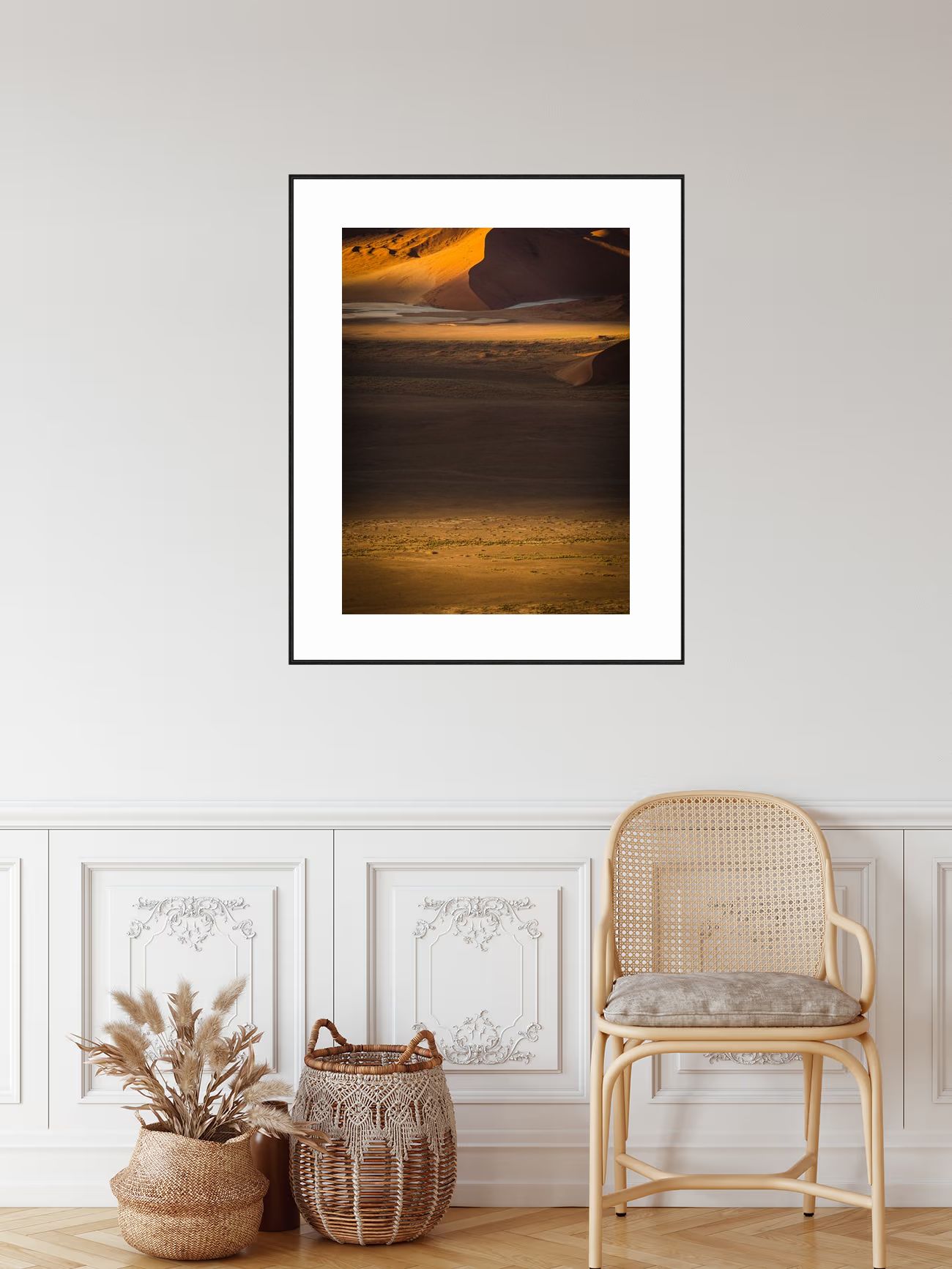
It's also the room you look at art from farthest away, often across the room from the sofa. Images with one strong, simple shape read well at that distance: a single dune ridge, a mountain against the sky, a horizon line. A busy image with lots of small detail loses that detail at ten feet.
If the wall gets sun for part of the day, choose metal. Paper behind UV-filtering glass will still fade faster.

Desert Spine, Sossusvlei, Namibia.
Bedroom
You look at bedroom art lying down, first thing in the morning and last thing at night, usually in low light. Quiet images work better here than dramatic ones: fog, still water, snow, blue-hour light, night skies. A storm that looks great in a living room is a lot to wake up to.
Above the headboard is the usual spot, but the wall you face from bed is the one you'll actually look at.

Stardust, Inverness, California.
Home office
Two walls matter. The one you face is where your eyes go between tasks, so pick something with depth, a view that goes a long way into the distance. In a room without a good window, it's the closest substitute.
The wall behind you is the one people see on video calls. A calm image with a clear horizon works well there. A busy one competes with your face.
Entryway
It's the first thing anyone sees, and you walk past it several times a day. One strong image works better than a group. Entries are often narrow, so a vertical print usually fits better than a wide one.

Dark Horse, Þórsmörk, Iceland.
Hallway
In a hallway you're close to the wall and moving. That suits images with detail you notice over time, like texture in rock, or small figures in a big landscape. Smaller prints work here, and three matching frames spaced evenly along a long hall look deliberate. Hallways tend to be dark, so a picture light is worth considering.
Kitchen and bathroom
Humidity rules out paper. Steam gets behind the glass and can ripple or stain a paper print over time. ChromaLuxe metal handles it, which makes this one of the few rooms where the material decides for you. See metal or paper.
A word on color
Don't match art to a cushion. The print will outlast the cushion. Pick the image first. If you want a link to the room, look for one color in the photograph that's already somewhere in the room, even in a small way, like the wood of a floor or the tone of a rug.
Quick answers
- What kind of art is best for a bedroom?
- Quiet, low-contrast images: fog, still water, snow and night skies. Dramatic images like storms are better suited to living spaces.
- Can you hang photographs in a bathroom?
- Yes, if they are printed on metal. Paper prints, even behind glass, can be damaged by steam over time.
- What art works in a narrow entryway?
- A single vertical print, sized to the wall and well lit.