How to Tell If a Photography Print Is Good Quality Before You Buy
By Ning Ma
Most of what makes a print good or bad doesn't show in a product photo. So ask. Anyone who prints well will be glad to answer these questions, and a vague answer tells you something too.
1. What is it printed on?
"Archival paper" isn't an answer. A good answer names the maker and the paper, and usually the weight: Hahnemühle Photo Rag, Canson Infinity Platine Fibre Rag, Epson Legacy Platine. Mine are Hahnemühle Photo Rag Metallic (340 gsm) and Museum Etching (350 gsm) for paper, and ChromaLuxe aluminum for metal.
Heavier paper, 300 gsm and up, handles better and lies flatter in a frame.
2. What inks, and is there a permanence rating?
On paper, pigment inks last far longer than dye inks, so ask which it is. Metal prints are the exception: they use dye, but the dye is sealed inside the coating, which is why they test so well.
For how long a print will last, the best evidence is a rating from an independent lab, usually Wilhelm Imaging Research, for that exact paper and ink. ChromaLuxe has one: 65 years with Epson UltraChrome DS inks. "Lasts 100+ years" with no source is marketing.
3. Is the file big enough for the size?
A print can only show the detail the file holds. The camera I use, a Nikon D850, makes files 8,256 pixels wide. Spread across 36 inches that's about 230 pixels per inch, which looks sharp at any normal viewing distance. At 13 × 19 there's detail to spare.
A heavily cropped image, or a phone photo stretched to 36 inches, can look soft up close. Ask what the image was shot on, or how many pixels it is.
4. Is the edition size the real total?
"Limited edition of 50" can mean 50 in each of several sizes. Ask for the total. See limited vs open editions.
5. Is it signed, and how?
Is the print itself signed, or only a separate card? For a limited edition, is there a certificate with a unique number?
6. How is it packed and shipped?
Large prints are more likely to be damaged in transit than anywhere else. Ask how it's packed. My prints are prepared over five business days and ship from California.
7. Can you see the real surface?
Mockups show you the composition. They don't show you the print. Ask for a photo of an actual print at an angle, or of a corner. Surface, texture and edges show up there.
If you can see it in person
- Tilt it under a light. The surface should be even, with no scuffs or fingerprints.
- Look at the shadows. Dark areas should still hold some detail rather than going flat black.
- Look at smooth skies. You shouldn't see steps or bands where the color changes.
- Look at the edges. They should be clean and square.

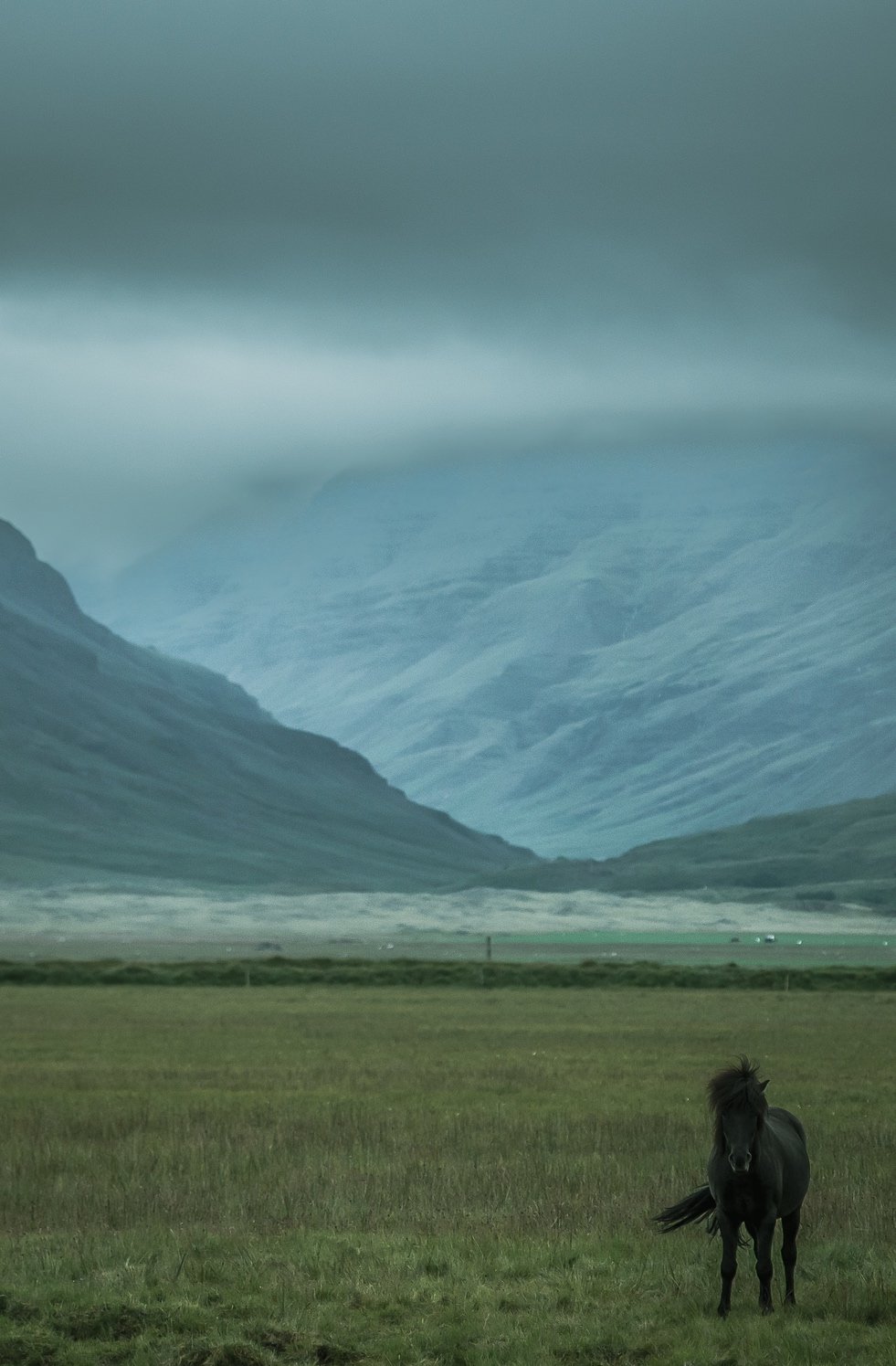
Dark Horse, Þórsmörk, Iceland.
Quick answers
- What is the best paper for photo prints?
- There is no single best. Cotton rag papers from established mills such as Hahnemühle, Canson Infinity and Epson, printed with pigment inks, are the standard for fine art prints.
- What does gsm mean on photo paper?
- Grams per square meter, a measure of paper weight. Fine art papers are usually 300 gsm or heavier.
- How many pixels do you need for a 24 × 36 print?
- For viewing from a few feet away, about 200 pixels per inch is plenty, which is 7,200 by 4,800 pixels. At 300 pixels per inch you would need 10,800 by 7,200.