
Photographing Sossusvlei and Deadvlei: Light, Timing and What to Expect
By Ning Ma
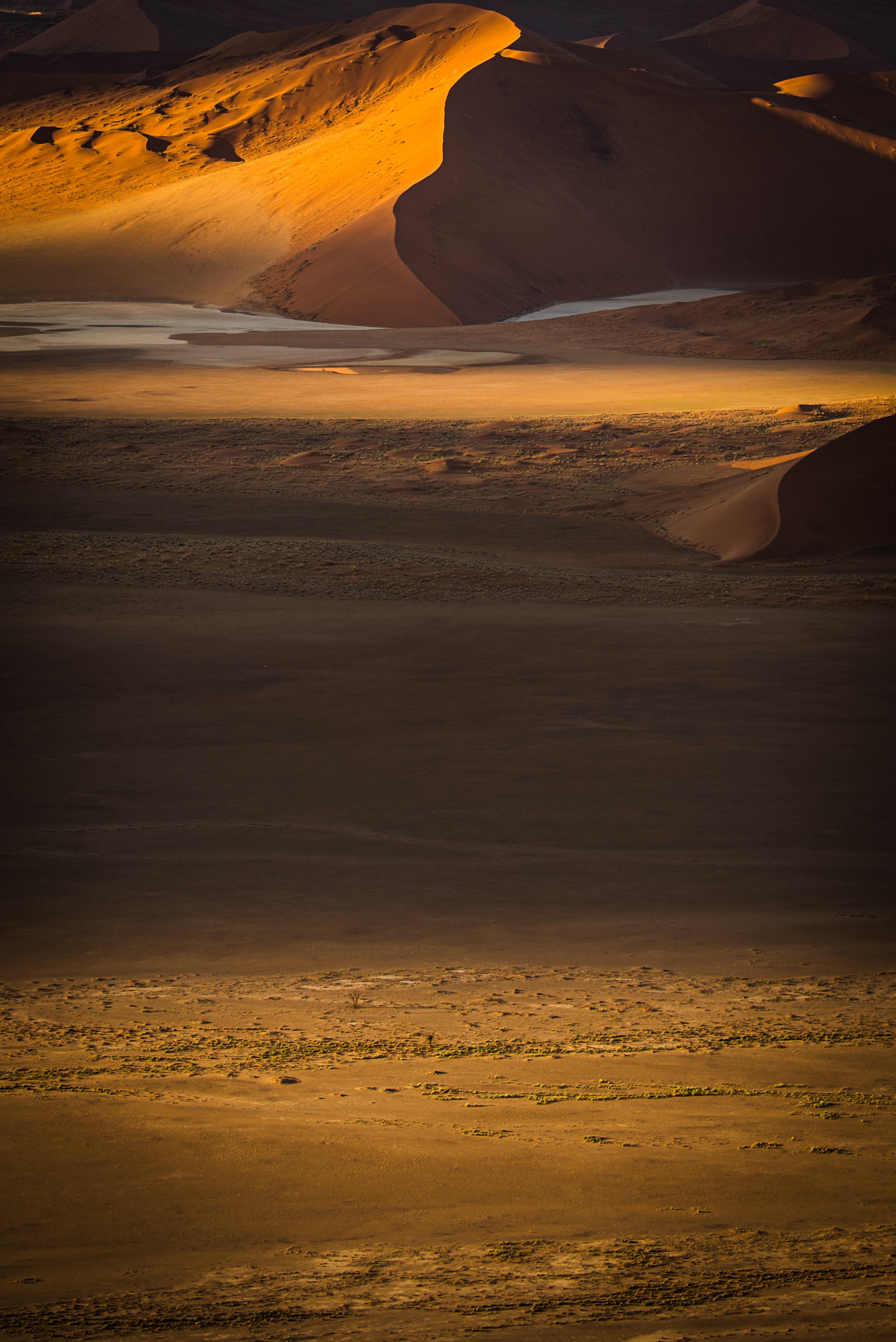
Go for the first hour after sunrise and the last hour before sunset. Sossusvlei is a place of ridges, and a ridge only shows when the sun is low enough to light one side and leave the other dark. By mid-morning the shadows are gone, the heat is up and the dunes look flat.
Where it is
Sossusvlei is a clay pan in the Namib-Naukluft National Park in Namibia, surrounded by some of the tallest sand dunes on Earth. The tallest near the pan, known as Big Daddy, rises about 325 meters. The Namib is often described as the oldest desert in the world. The sand is red because the grains are coated in iron oxide, and the older the dune, the deeper the red.
The park gate is at Sesriem. From there a paved road runs about 60 kilometers down the dune valley to a car park. The last five kilometers are deep sand, and you need a four-wheel drive or the park shuttle.
The dunes
Almost every dune photograph I have from Namibia depends on a single line: the crest, where the lit side meets the shadow side.
Queen's Gambit, at the top of this page, is that line at its simplest. One ridge, one edge catching the morning light, deep shade behind it.

Queen's Gambit, Sossusvlei, Namibia.
Serpentine is the same idea with a curve in it. The crest bends in an S, with orange sand on one side and a pale green valley floor on the other.

Serpentine, Sossusvlei, Namibia.
Switzerland steps back until the ridges repeat. Lit crests and dark troughs run to the horizon like waves. Marble does the opposite and looks only at the surface, where curves and hollows in the sand turn into pattern.
Scale
Nothing in the Namib tells you how big it is until a person walks into the frame. The Human Experience is a black and white photograph of a dune with a few tiny figures on its spine. Without them it could be a ripple of sand a meter high. With them you can read the size of everything.

The Human Experience, Sossusvlei, Namibia.
Desert Spine shows the path they walk: a narrow crest marked with footprints, dropping away on both sides. Climbing a dune means following that crest, and it is slow. Every step slides half a step back. Go early, carry more water than you think you need, and expect sand in everything, cameras included. Change lenses out of the wind or not at all.
Deadvlei
Deadvlei is a white clay pan about a kilometer on foot from the end of the road. Its name means dead marsh. Camel thorn trees grew there when the river still reached it. The dunes cut the water off several hundred years ago and the trees died, but the air is so dry that they never rotted. They stand black on white clay, with red dunes and blue sky behind them.
The Ballerina photographs were made there. Each is a single tree or a pair, and the shapes do look like dancers.

Ballerina I, Sossusvlei, Namibia.
The pan sits in a bowl of dunes, so the sun reaches it later than the dunes around it. For a while the trees and the clay are in shade while the dune behind them is lit.
From the air, and on the plains
Hot-air balloons fly over the dunes at dawn. Clairvoyance is one of them, alone in gold haze above the desert.
Around Sesriem the sand gives way to gravel plains and grass, and there is more wildlife than you would guess. Nothing But Air is an oryx in full stride. In Hide and Seek, a herd is almost lost in tall golden grass.
When to go
The cooler months, roughly May to September, are the easiest. Days are mild, nights are cold and the air is clear. Summer is very hot.
All of the Namibia photographs are in the Africa gallery.
Quick answers
- What is the best time of day to photograph Sossusvlei?
- The first hour after sunrise and the last hour before sunset. Low sun lights one side of each dune and leaves the other in shadow, which gives the ridges their shape.
- Why are the trees in Deadvlei black?
- They are camel thorn trees that died several hundred years ago when the dunes cut off their water. The air is too dry for them to rot, and the sun has darkened the wood.
- Why is the sand in Sossusvlei red?
- The grains are coated in iron oxide. Older dunes have had longer to oxidize and are a deeper red.
- Do you need a 4x4 to reach Sossusvlei?
- Only for the last five kilometers, which are deep sand. The road from the Sesriem gate to the car park is paved, and a park shuttle covers the sandy stretch.