Why the People in My Photographs Are So Small
By Ning Ma
The people in my photographs are small because that is how big people are. Put a climber on Aconcagua or a walker on a dune in Namibia and they are a speck. I leave them that way on purpose, and the idea comes from Chinese landscape painting.
Shan shui
Chinese landscape painting is called shan shui hua (山水画). Shan is mountain and shui is water, so the name means mountain and water painting. It took the form people recognize today about a thousand years ago, during the Song dynasty.
Three things mark the tradition, and I borrow all of them.
People are small. In Fan Kuan's Travelers Among Mountains and Streams, painted around the year 1000, a cliff fills most of a scroll two meters tall. The travelers of the title are a mule train at the very bottom, a few brushstrokes high. You can miss them on a first look. Once you find them, the mountain gets bigger.
Empty space is part of the picture. Mist, water and bare silk take up as much room as rock. The blank areas are not unfinished. They are where the eye rests, and they let the mountain float.
The painting is about being there, not about a view. The painters did not set up in front of a scene and copy it. They walked the mountains, and painted what the place was like afterward.
How that shows up in a photograph
A camera cannot leave silk bare, but it can do the other two things.
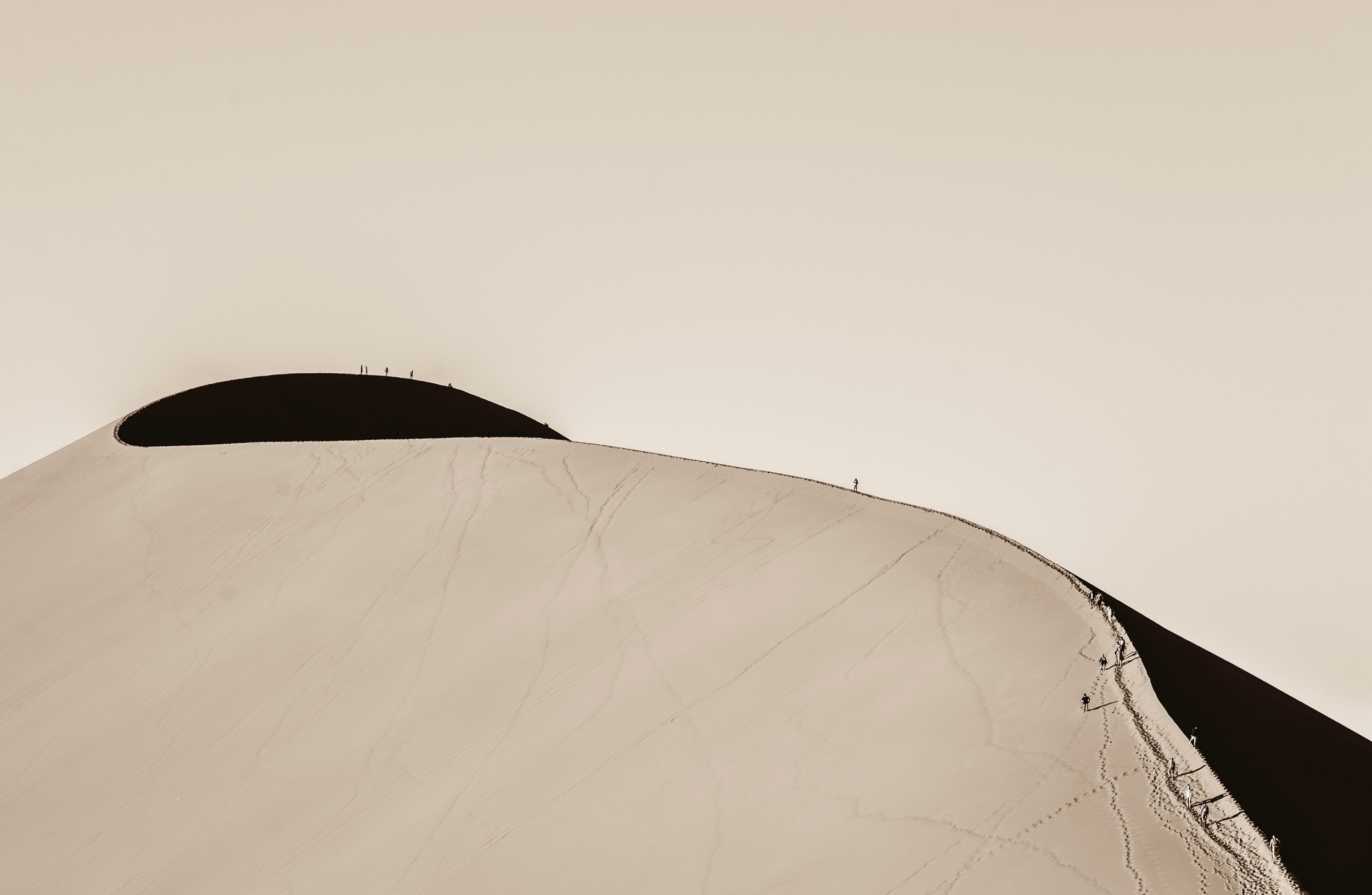
The Human Experience is a dune in Namibia, in black and white, with a few figures walking along its spine. They are the only way to tell how large the dune is.

The Human Experience, Sossusvlei, Namibia.
Into the Void and The Long Walk are from Aconcagua. In both, hikers cross a wide field of rock, and the peaks and sky around them take up nearly all of the frame. The mule trains that carry supplies to base camp are in other photographs from the same climb, which is about as close to Fan Kuan's travelers as a photograph can get.

Into the Void, Mount Aconcagua, Argentina.
In Skywalkers, also from Aconcagua, the figure is a paraglider, one dot in a sky over red-brown ridges.
For the empty space I rely on weather. Fog, low cloud, spray from a waterfall and a white sky all do what bare silk does in a painting. They take things away, and what is left gets more room.
Why it matters to me
This tradition is where my idea of a landscape picture comes from. It is not a record of a famous view. It is a way of putting a person back at their real size.
Cities make it easy to believe people run the place. An hour on a mountain corrects that. The figures in my photographs are there to make the same correction.
I also do not add or remove anything afterward. No composites and no replaced skies. If there is a person in the frame, that person was there, and that small.
More about how I work is on the philosophy page. The mountain photographs are in the Aconcagua, Kilimanjaro and Elbrus galleries.
Quick answers
- What does shan shui mean?
- Mountain and water. Shan shui hua (山水画) is the Chinese tradition of landscape painting, which took its classic form during the Song dynasty about a thousand years ago.
- Why are the figures so small in Chinese landscape paintings?
- To show people at their true scale against mountains and water. A tiny figure also makes the landscape around it read as larger.
- Does Ning Ma composite or edit people into photographs?
- No. Nothing is added or removed. If a person appears in a photograph, they were there.