
Reading a Supercell: A Guide to My Tornado Alley Storm Photographs
By Ning Ma
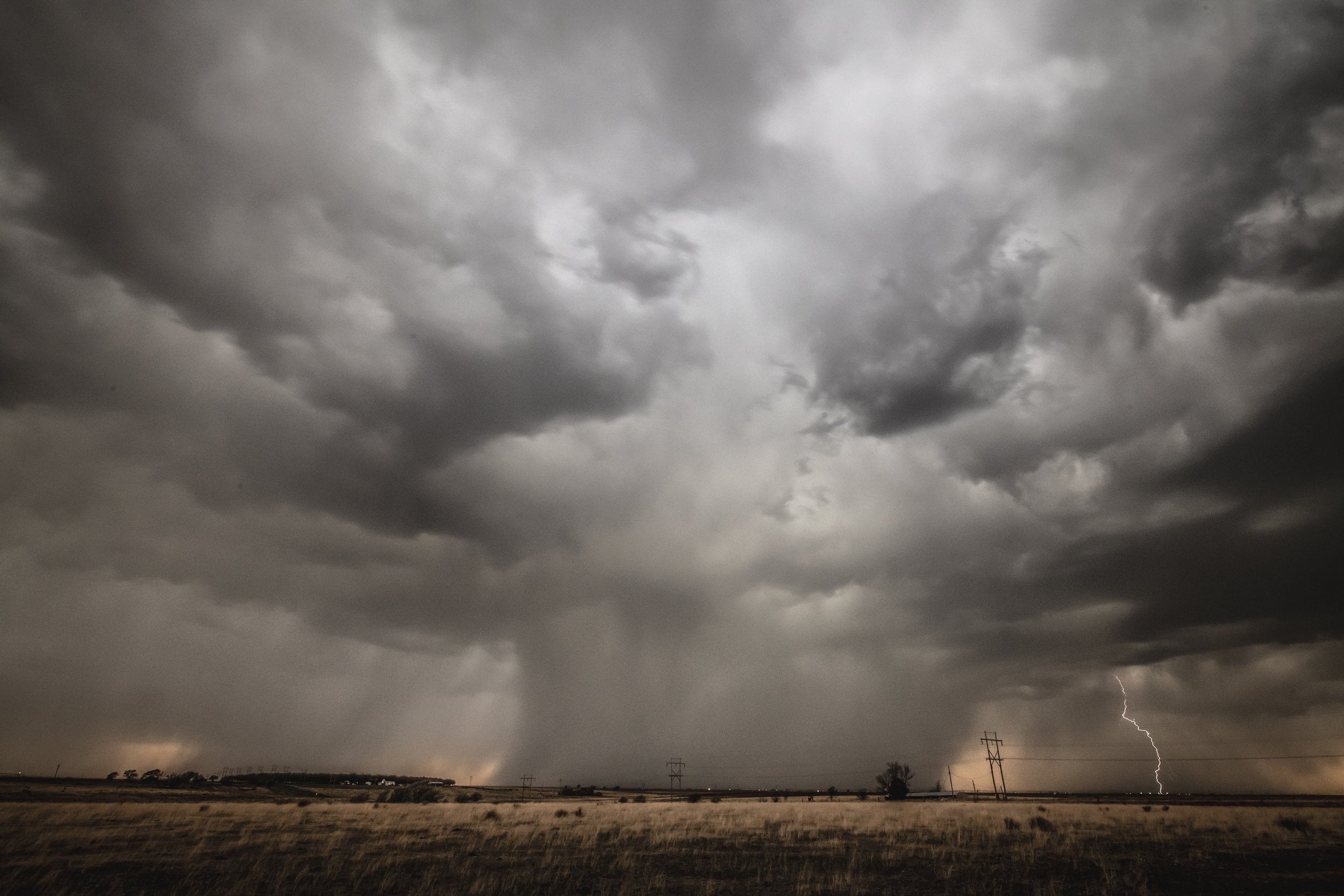
A supercell is a thunderstorm with a deep, rotating updraft called a mesocyclone. It's the kind of storm behind most strong tornadoes. It's also the most photogenic storm there is, because the rotation organizes the cloud into shapes you can see from miles away: a striped, tilted tower, a lowered wall cloud, a flat anvil spreading across the top.
The storms in my storms collection were photographed in Tornado Alley, the part of the Great Plains that runs north from Texas through Oklahoma and Kansas. Here is what you're looking at in them.
The updraft tower
In Silent Spring and Before Impact, the storm looks layered, like a stack of plates. Those bands, called striations, come from the rotating updraft. Air is spiraling up into the storm, and the cloud takes the shape of that motion.

Silent Spring, Tornado Alley, USA.
The wall cloud
The Menace shows a wall cloud, a lowered section of cloud hanging under the base of the updraft. It often rotates. When a supercell produces a tornado, it usually comes from here.
The green cast in that photograph shows up in some severe storms. It's usually linked to storms carrying a great deal of water and hail, lit by low sun, though exactly why it happens is still studied.

The Menace, Tornado Alley, USA.
The anvil
When the updraft reaches the top of the lower atmosphere, around 40,000 to 50,000 feet on the Plains, it can't rise any further and spreads out sideways. That flat top is the anvil. Residual Flow shows one from a storm that's winding down, with light coming through its edges.

Residual Flow, Tornado Alley, USA.
Towering cumulus
Unspent and Cotton Candy are earlier. They show towering cumulus, clouds growing fast on a hot afternoon, some of which will become storms and most of which won't.
Rain shafts, and the road
In Threshold Rising you can see rain shafts, gray columns of rain falling from the storm base, beside the highway. Storm chasing is mostly driving, and half the photographs in the collection have a road in them.

Threshold Rising, Tornado Alley, USA.
Lightning
Zero Hour was made at twilight, when there's still enough light in the sky to show the storm's shape and it's dark enough for lightning to stand out. Thor's Hammer is the one exception in the collection: two lightning bolts over downtown Brooklyn, not the Plains.
If you want to see one
Supercell season on the southern Plains peaks in May and early June. Storms move fast, roads flood, and hail can break a windshield, so don't go alone without experience. Many photographers go with an established storm-chasing tour led by experienced forecasters. Give the storm plenty of distance. A wide lens helps: the structure of a supercell can fill most of the sky.